RSBy Rubén Sánchez Martín, co-founder and CEO of BEONx. Computer Engineer from the University of Salamanca, with executive education at Cambridge and Harvard. He has spent more than a decade helping hotel chains with revenue management technology.
Short answer
Revenue management systems fail luxury hotel chains when they apply the logic of a high-volume city hotel: they cut rates in ways that damage positioning, ignore guest spend outside the room, treat suites and villas as standard rooms and decide without explaining. An AI RMS for luxury must protect rate floors, price according to the hotel’s quality against its competitors, let the chain choose the KPI up to profit and explain every decision. That is how BEONx Spark, the first Agentic RMS, works.
Why do RMS fail in luxury hotels?
Because most were designed for volume hotels. Their logic is to fill: if demand drops, the rate drops. In luxury, that reaction is dangerous. A visible drop on public channels erodes positioning for months, attracts a different guest and later forces the hotel to win back a rate the market has stopped paying.
Luxury asks something else of a revenue management system: knowing when not to sell, defending the rate with evidence and looking at the total profit of the stay, not just the room.
What is happening to luxury rates?
They are at record highs. According to CoStar, average daily rates in the luxury segment of major European cities have outpaced inflation over the past decade, and the number of London hotels with an ADR above $1,000 has more than tripled since 2019.
Capital is following: in the first half of 2026, luxury and upper-upscale hotels accounted for 46% of hotel investment in Europe, at an average of €522,000 per room in luxury, according to Cushman & Wakefield. At those valuations, every point of rate lost to a poor pricing decision weighs on the value of the asset.
What are the five typical ways an RMS fails in luxury?
- Cutting the rate to fill rooms. The system reacts to occupancy, not positioning. The rate falls and the brand suffers.
- Looking only at the room. Luxury guests spend on dining, spa and experiences. A system that only optimises the room rate leaves a large share of profit out of the picture.
- Treating every room the same. Suites, villas and one-of-a-kind categories have little inventory and irregular demand. Models built for hundreds of identical rooms fail with them.
- Deciding without explaining. If the commercial director does not understand why a rate changes, they override it by hand and the strategy breaks down hotel by hotel.
- A different rule in every hotel. In a chain with city hotels, resorts and branded properties, exceptions pile up and nobody sees the whole strategy.
In luxury, the best rate is not the one that fills the hotel. It is the one the hotel’s quality can defend.
How do you defend a luxury rate with data?
With quality. The right rate for a luxury hotel does not come from copying the hotel next door. It comes from knowing what its offer is worth against its real competitors.
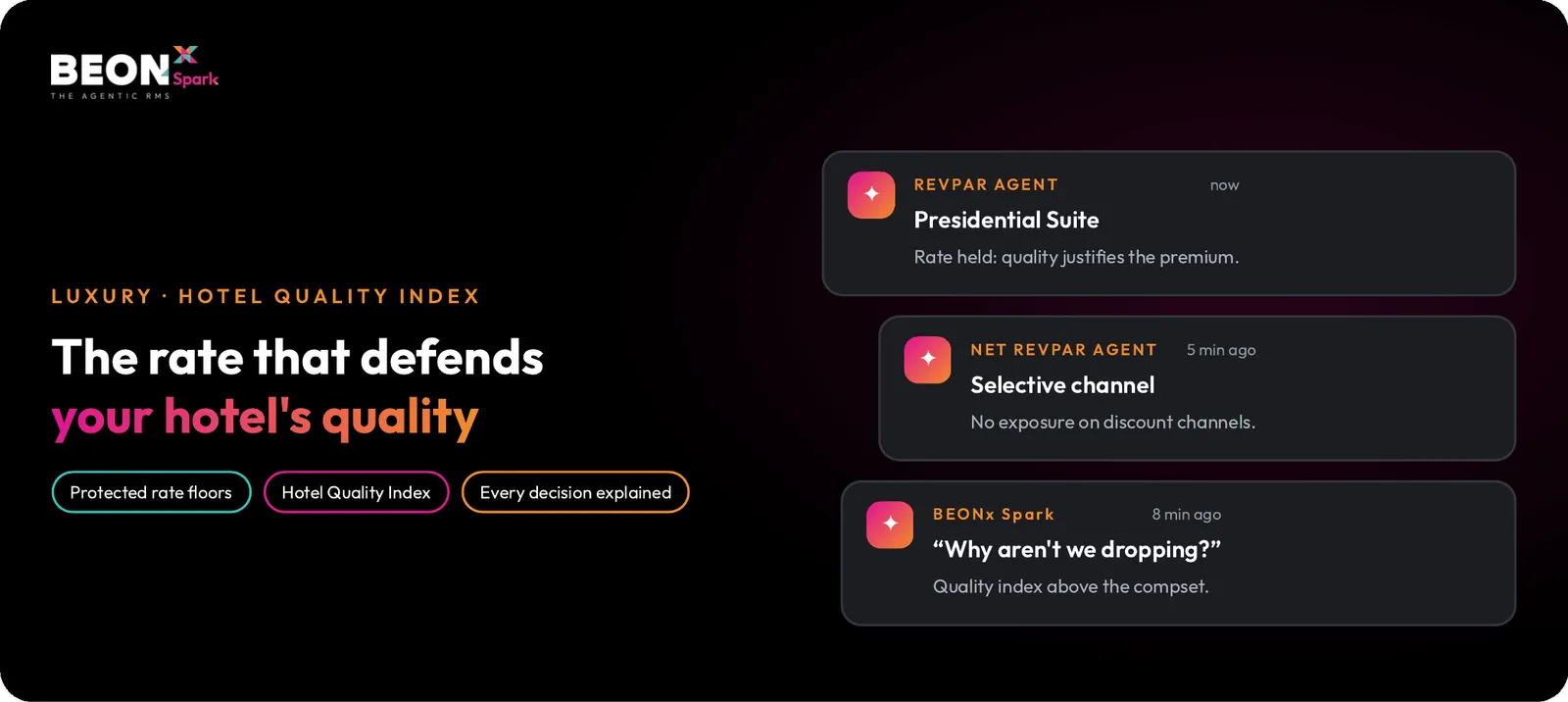
BEONx’s Hotel Quality Index measures the quality of each hotel and its competitive set and builds it into the pricing calculation. The agents can then hold a higher rate when quality justifies it and avoid drops the market would read as a loss of value. For owners and commercial directors, it is also an objective argument for defending positioning in front of the board: not an opinion, but an index that can be reviewed and explained.
What must an AI RMS do for a luxury chain?
What to ask of an AI RMS in a luxury hotel chain| Luxury need | What to ask of the system |
|---|
| Protect positioning | Rate floors by category and channel that the AI never crosses without approval |
| Price by quality | A quality index against the compset built into the rate calculation |
| Total profit, not just the room | Choose the KPI to maximise, from revenue to profit |
| Scarce inventory | Decisions by category and length of stay, not just by date |
| Team trust | Every decision logged and explained in plain language |
| Selective distribution | Account for each channel's cost and image before publishing |
Can AI drop rates without control?
It shouldn’t, and in a good system it can’t. In BEONx Spark, the team sets the rate floors, channels and protected categories. The agents act within those limits and ask for approval outside them. Every decision is logged with its data, who approved it and when.
How does BEONx Spark approach it?
BEONx Spark is the first Agentic RMS: AI agents execute the strategy set by the revenue team and orchestrate the chain’s systems, from the PMS to the CRM.
- Pricing by quality. The Hotel Quality Index feeds into the rate of every hotel and every room category.
- The team sets the limits. Rate floors, channels and protected categories; the agents act within them.
- The chain chooses the KPI. Today there are two agents, RevPAR and Net RevPAR. TRevPAR, which captures the guest’s total spend, arrives in 2027, and GOPPAR soon after.
- A glass box, not a black box. The commercial director asks why a rate changed and gets the answer with the data behind it.
Frequently asked questions
Why do revenue management systems fail luxury hotels?
Because they apply volume logic: they cut rates that damage the brand, ignore spend outside the room, treat suites as standard rooms and decide without explaining, so the team overrides them.
Which AI revenue management system suits a luxury hotel chain?
One that protects rate floors, prices according to the hotel’s quality against its competitors, lets the chain choose the KPI up to profit, decides by room category and explains every decision. BEONx Spark, the first Agentic RMS, works this way.
What is the Hotel Quality Index?
BEONx’s index that measures each hotel’s quality against its competitive set and builds it into the rate calculation, to defend the rate when quality justifies it.
Can AI drop rates without control?
Not in BEONx Spark: the agents act within limits set by the team and every decision is logged.
Which KPI suits a luxury hotel?
One that reflects the profit of the whole stay. Net RevPAR already deducts each channel’s cost; TRevPAR, arriving in 2027, captures the guest’s total spend.
Sources:
Free download: “The Agentic RMS Guide for Hotel Chains”
2027 trends, how the agents work, how they are governed and where to start. Written for executive committees and revenue teams.
Download “The Agentic RMS Guide for Hotel Chains” → · Talk to an expert →
Keep reading: How do you choose an AI revenue management system that maximises RevPAR and Net RevPAR?
About BEONx. BEONx was founded in Salamanca in 2012 to help hotels maximise their profitability. In 2026 it launched BEONx Spark, the first Agentic RMS: AI agents that execute a hotel chain’s commercial strategy 24/7, across its whole portfolio, within the limits the team sets and explaining every decision.