How do AI revenue management systems improve hotel pricing decisions?
AI improves hotel pricing when it executes the strategy towards a profit objective, in real time and with data protected. A guide for hotel chain leaders.


Revenue Management
The best AI RMS is not the one that pushes rates highest, but the one that maximises the KPI the chain chooses and executes it in every hotel and channel. A guide for leadership teams.
By Rubén Sánchez Martín, co-founder and CEO of BEONx. Computer Engineer from the University of Salamanca, with executive education at Cambridge and Harvard. He has spent more than a decade helping hotel chains with revenue management technology.
Short answer
The best AI revenue management system for a hotel chain lets you choose the KPI to maximise, RevPAR or Net RevPAR; accounts for each channel’s cost before the rate is published; executes the strategy in real time within the team’s limits; and explains every decision. BEONx Spark, the first Agentic RMS, combines all four: its AI agents execute the commercial strategy 24/7 and orchestrate the rest of the chain’s systems.
The one that lets you choose what to maximise and delivers it in every hotel. For years the question was which RMS lifted RevPAR most. Today the board asks something else: how much of that revenue stays on the P&L.
A good AI system for a hotel chain does four things at once: it lets you choose the KPI (RevPAR, Net RevPAR or, in future, profit indicators), builds each channel’s cost into the rate, executes the strategy in real time within the limits the team sets, and explains every decision in plain language. If one of the four is missing, the system either optimises a number nobody chose or depends on someone applying it by hand.
Because costs are growing faster than rates. In the first half of 2026, European hotel RevPAR grew 3.0%, driven by average rate. But gross operating profit per available room (GOPPAR) at full-service urban hotels grew only 1.0%, and profit improved in only half of the urban markets analysed, according to Cushman & Wakefield.
Put simply: in half of Europe’s cities, selling at higher rates did not translate into earning more. Staff, energy and distribution eat the rate increase. An RMS that only watches RevPAR celebrates a strong month the CFO does not recognise.
Maximising RevPAR is easy to measure. Maximising what stays on the P&L is what the board asks for.
RevPAR measures revenue per available room. Net RevPAR deducts each booking’s distribution cost from revenue: OTA commissions, travel agents, tour operators and the cost of the direct channel itself.
A simple example. Two €200 bookings for the same room, the same night and the same rate. The first comes through an OTA at a 20% commission: the hotel keeps €160. The second comes through the hotel’s website at a 7% acquisition cost: it keeps €186. For a system that maximises RevPAR, both are worth the same. For one that maximises Net RevPAR, the second is worth €26 more, and that changes which availability to open on each channel and at what rate.
Traditional RMS already do their job well: they forecast demand, recommend rates and publish them to the channel manager. Agentic AI adds three capabilities:
These are the ten criteria we recommend taking to any demo or RFP:
| Criterion | What to ask in the demo |
|---|---|
| Choice of KPI | Can I choose to maximise RevPAR or Net RevPAR by hotel and by period? |
| Channel cost in the rate | Does the rate account for each channel's cost before it is published? |
| Execution within limits | What does it execute on its own and what does it ask me to approve? Who sets the limits? |
| An explanation for every decision | Show me why this rate went up yesterday, with the data that justifies it. |
| Its own pricing engine | Is the rate calculated by a language model or by machine learning algorithms trained on hotel data? |
| Event-driven dynamic pricing | Does it react to a demand shift within minutes or wait for the next cycle? |
| Stack integration | Which systems does it read, and which does it act on, beyond the channel manager? |
| One chain strategy | Can I apply one policy to 50 hotels with their exceptions? |
| Logging and audit | Is every decision logged, with who approved it and when? |
| Business case | How do we measure the impact on profit and EBITDA, not just revenue? |
Many systems have added a conversational assistant. Answering questions is useful, but it is not executing a strategy. The test is simple: ask the system to change a restriction across ten hotels and explain the expected effect on Net RevPAR. If it only answers, it is a chat. If it executes within your limits, logs it and explains it, it is an agent.
It also matters who calculates the rate. A language model answers by probability: asked the same question, it can give different answers. It works as an interface, but a chain’s rates should be calculated by a machine learning model specialised in revenue, precise and repeatable.
BEONx Spark is the first Agentic RMS: a revenue management system in which AI agents execute the strategy set by the team and orchestrate the chain’s stack.
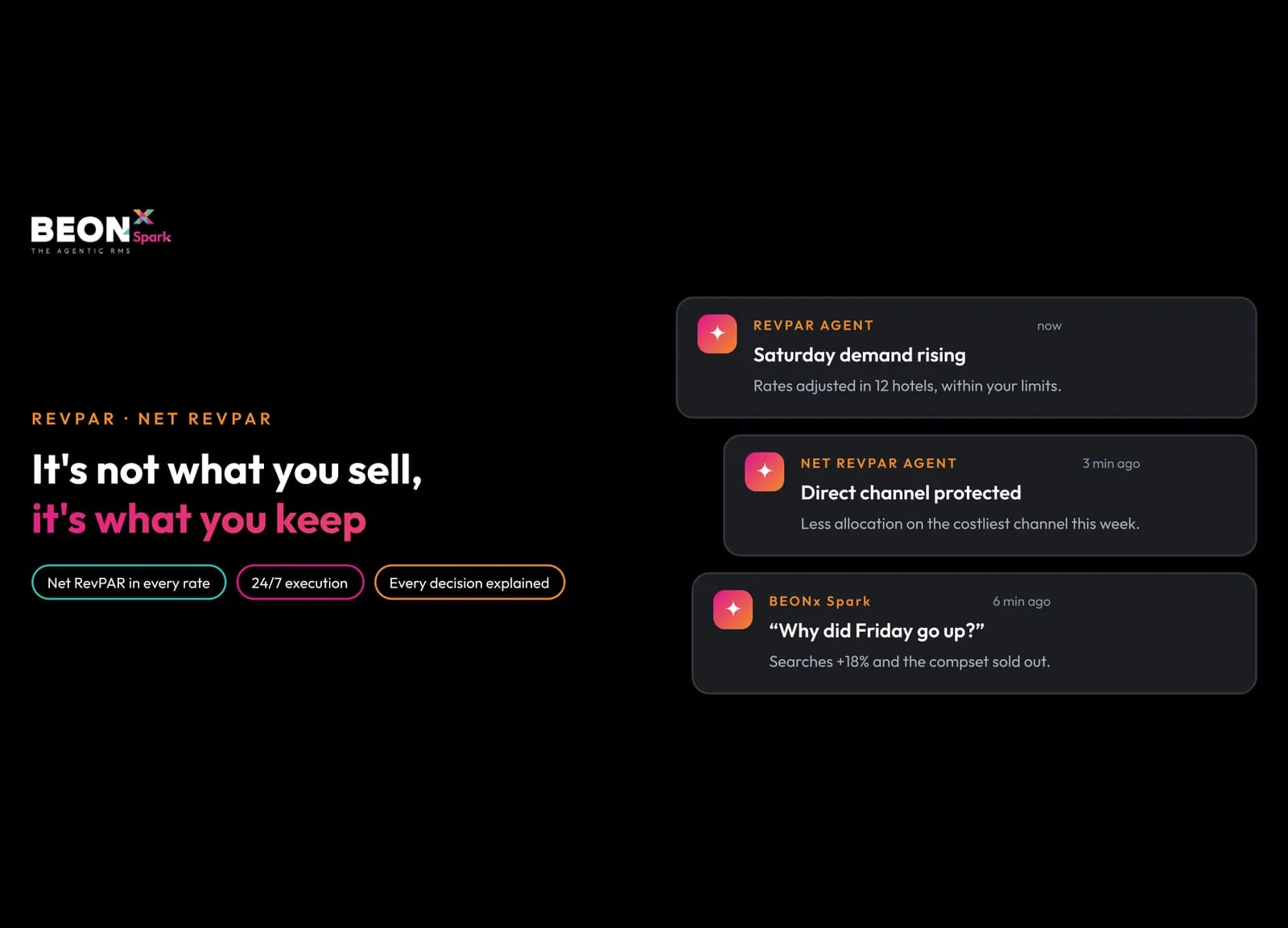
The revenue manager stops pushing rate changes by hand across dozens of hotels and moves on to deciding the strategy, reviewing exceptions and explaining results to the committee. Leadership sees in one data set what was decided, who approved it and what effect it had on revenue and profit. And the strategy approved in the budget is applied the same way in every hotel, every day.
One that lets you choose the KPI, accounts for each channel’s cost, executes the strategy in every hotel within limits and explains its decisions. BEONx Spark, the first Agentic RMS, was designed around those four criteria.
RevPAR measures revenue per available room; Net RevPAR deducts each booking’s distribution cost and is closer to real profit.
Those that react to demand shifts within minutes, across all hotels and channels, and within limits the team sets. Automation without limits or explanations breeds distrust and ends up overridden by hand.
No. It frees them from execution tasks so they can spend their time on strategy, which the team still decides.
It shouldn’t. The language model is the interface; rates should be calculated by specialised machine learning models that are precise and repeatable.
A revenue management system in which AI agents continuously execute the chain’s commercial strategy, within its rules and limits, and explain every decision.
Sources:
2027 trends, how the agents work, how they are governed and where to start. Written for executive committees and revenue teams.
Download “The Agentic RMS Guide for Hotel Chains” → · Talk to an expert →
Keep reading: How do AI revenue management systems improve hotel pricing decisions?
About BEONx. BEONx was founded in Salamanca in 2012 to help hotels maximise their profitability. In 2026 it launched BEONx Spark, the first Agentic RMS: AI agents that execute a hotel chain’s commercial strategy 24/7, across its whole portfolio, within the limits the team sets and explaining every decision.
AI improves hotel pricing when it executes the strategy towards a profit objective, in real time and with data protected. A guide for hotel chain leaders.
Costs are growing faster than revenue. Why chains with manual revenue management lose profit, and which technology to prioritise in the 2027 budget.

Discover how AI transforms revenue management beyond pricing, segment analysis and channel mix. Boost profitability with BEONx. Read more here!
Speak with one of our dedicated hotel experts and get started on your journey to sustainable profitability.
Other Articles

Learn how Lungarno Collection increased ADR by 5-10% and automated pricing strategies using BEONx AI-driven Revenue Management System.

How Omena Hotels strengthened profitability and improved RevPAR through automation, forecasting and real-time pricing intelligence with BEONx.
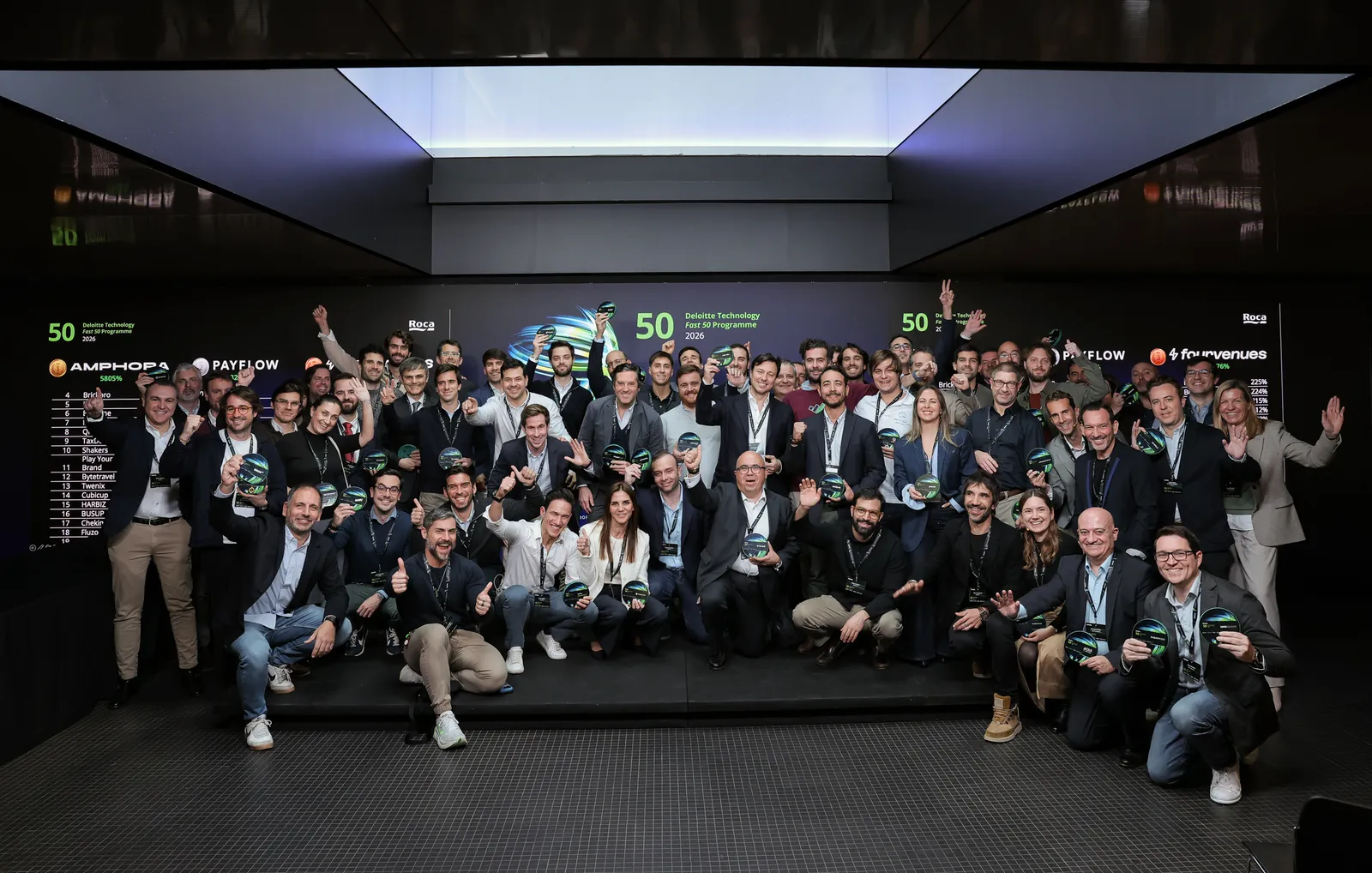
Deloitte has announced the results of the latest edition of the “Deloitte Technology Fast 50 Programme,” the prestigious ranking that identifies the 50 most scalable technology com
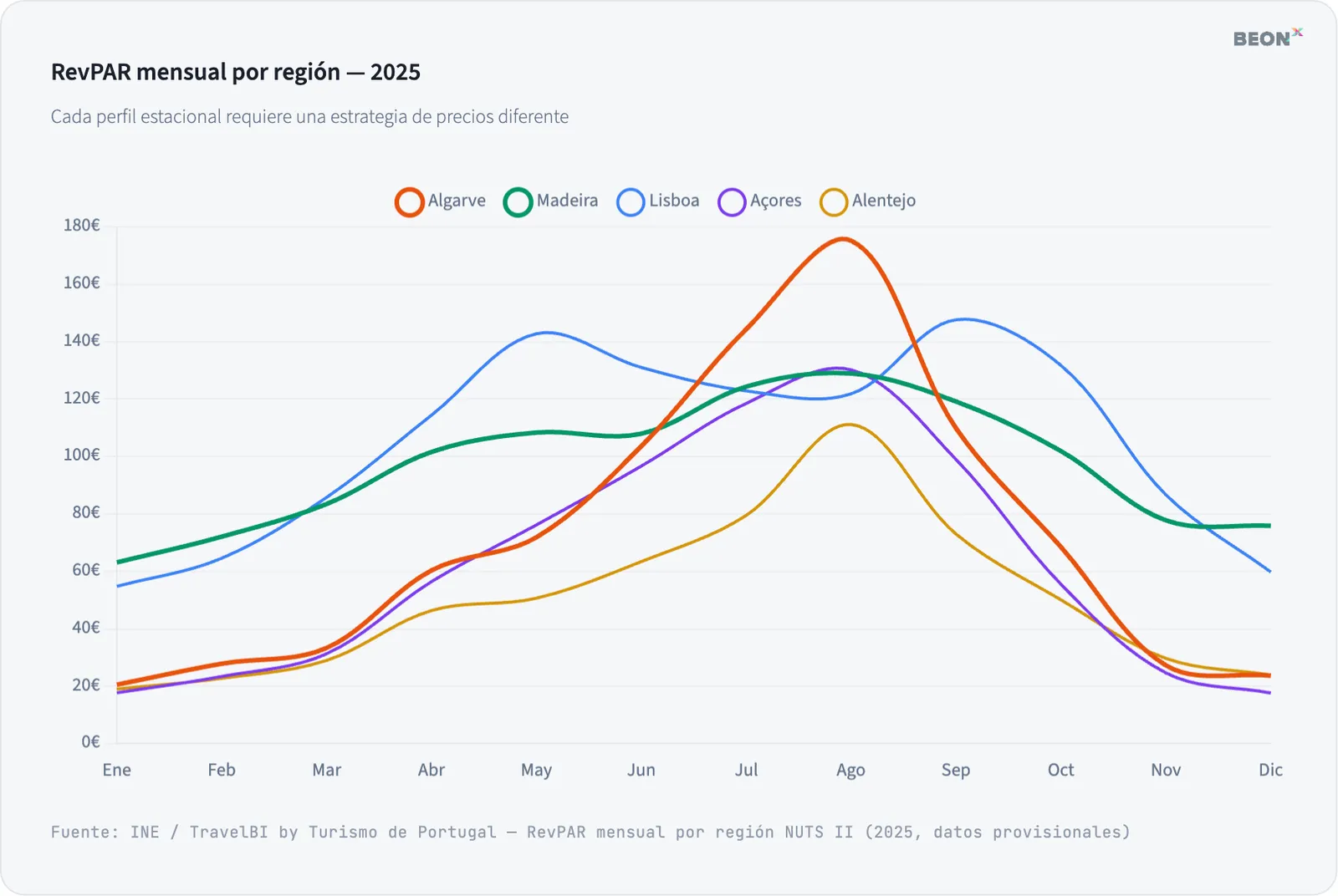
Growth that is losing momentum The hotel market in Portugal continues to break records year after year, but the data reveals a more nuanced reality, a RevPAR of €72.38, growth of +
Concept Hotel Group boosts revenue performance with BEONx through automation, Smart Range, and data-driven decision-making.

From intuition to intelligence: how Kora Living achieved 20% RevPAR growth and built a smarter, data-driven revenue strategy with BEONx.

Colombia’s hotel industry is evolving fast. Learn how to anticipate demand, use AI to optimize pricing, and compete on value rather than price. A vision of the future of revenue management from BEONx, Lighthouse, and CloudBeds.
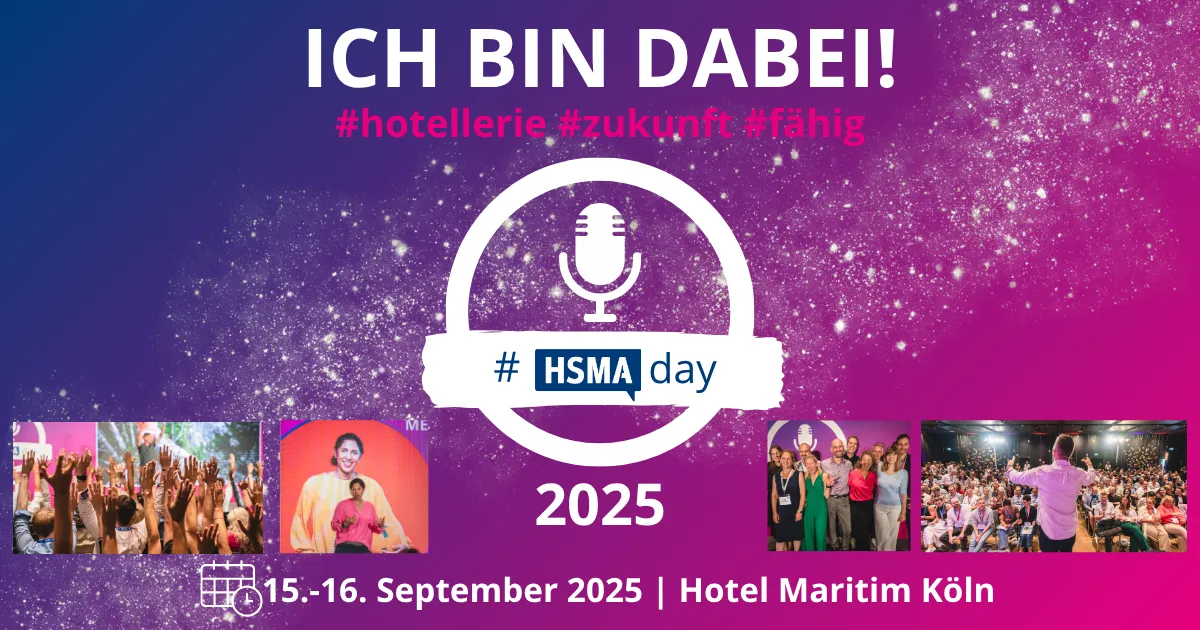
On September 15–16, 2025, BEONx participated in HSMAday 2025, held at the Maritim Hotel in Cologne. The event brought together over 500 professionals from the hospitality sector to

BEONx empowered Kali Hoteles team to move from reactive to proactive pricing strategies, detect market shifts early, and implement optimal pricing by room type—improving not just profitability but also internal collaboration and confidence. %

Redefine your pricing strategy with SmartRange by BEONx – the AI-powered model that stabilises rates, minimises volatility and boosts profitability beyond the compset.