Why do hotels miss profit with manual revenue tools?
Costs are growing faster than revenue. Why chains with manual revenue management lose profit, and which technology to prioritise in the 2027 budget.


Revenue Management
AI improves hotel pricing when it executes the strategy towards a profit objective, in real time and with data protected. A guide for hotel chain leaders.
By Rubén Sánchez Martín, Co-founder and CEO, BEONx. Computer engineer from the University of Salamanca, with executive education at Cambridge and Harvard. He has spent more than a decade helping hotel chains maximise profitability with revenue management technology. Endeavor Entrepreneur.
Short answer
AI improves pricing decisions when it stops being a tool that calculates and becomes a system that executes the chain’s strategy towards the right objective. That takes three things: specialised machine learning models with high accuracy in forecasting and pricing, a profit objective (Net RevPAR, not just RevPAR) and agents that act in real time within the chain’s rules, limits and security policies. BEONx Spark, the first Agentic RMS, brings all three together: its AI agents execute the commercial strategy 24/7, explain every decision and keep the business model in the system, not in people.
It does three things better than any team working with spreadsheets. It uses more data: each hotel’s history, destination demand, competitor rates, channel availability and city events. It forecasts with greater accuracy: it builds a multi-level machine learning forecast for each hotel and segment, including groups, corporate and tour operators. And it reacts sooner: when searches rise or competitors close availability, the price changes before bookings come in.
That is what the industry has been waiting for from AI, and the bet now sits with CEOs: according to BCG’s AI Radar 2026, companies will double their AI investment this year and nine in ten CEOs expect agents to deliver measurable ROI in 2026. But a more accurate price does not, on its own, guarantee more profit. That takes three more things: the right objective, the ability to execute and a system the board can trust.
Because a language model answers by probability: faced with the same scenario, it can give different answers. That is fine for drafting an email, but not for a decision that hits the P&L of fifty hotels. A general-purpose AI also lacks each hotel’s history and compset, cannot execute in the PMS or channel manager and does not know the chain’s commercial policies.
The systems that work combine two layers. Language models are the interface: they let you ask, configure and understand in plain language. The forecast and the price are calculated by machine learning models specialised in revenue, built to be precise, consistent and repeatable. With BEONx Spark, the chain also chooses which language model it works with, including its own.
The language model is the interface. The price is calculated by specialised models. Confusing the two is the most expensive mistake of 2026.
Because the objective matters as much as the algorithm. Hotel costs are growing faster than revenue: CBRE expects European RevPAR growth to slow in the second half of 2026 while costs keep squeezing operating profit, and in Latin America EY finds that RevPAR growth rests on rate, not occupancy. In that scenario, an AI that only maximises RevPAR can fill the hotel through the most expensive channels and hit the revenue target while missing the profit target.
So the key question when evaluating pricing AI is not only how accurate its price is, but which objective it pursues. BEONx Spark works with agents specialised by objective: the RevPAR Agent maximises revenue per available room and the Net RevPAR Agent maximises what is left after paying each channel, with tour operator allotments and releases inside every decision. TRevPAR arrives in 2027 and GOPPAR is coming soon.
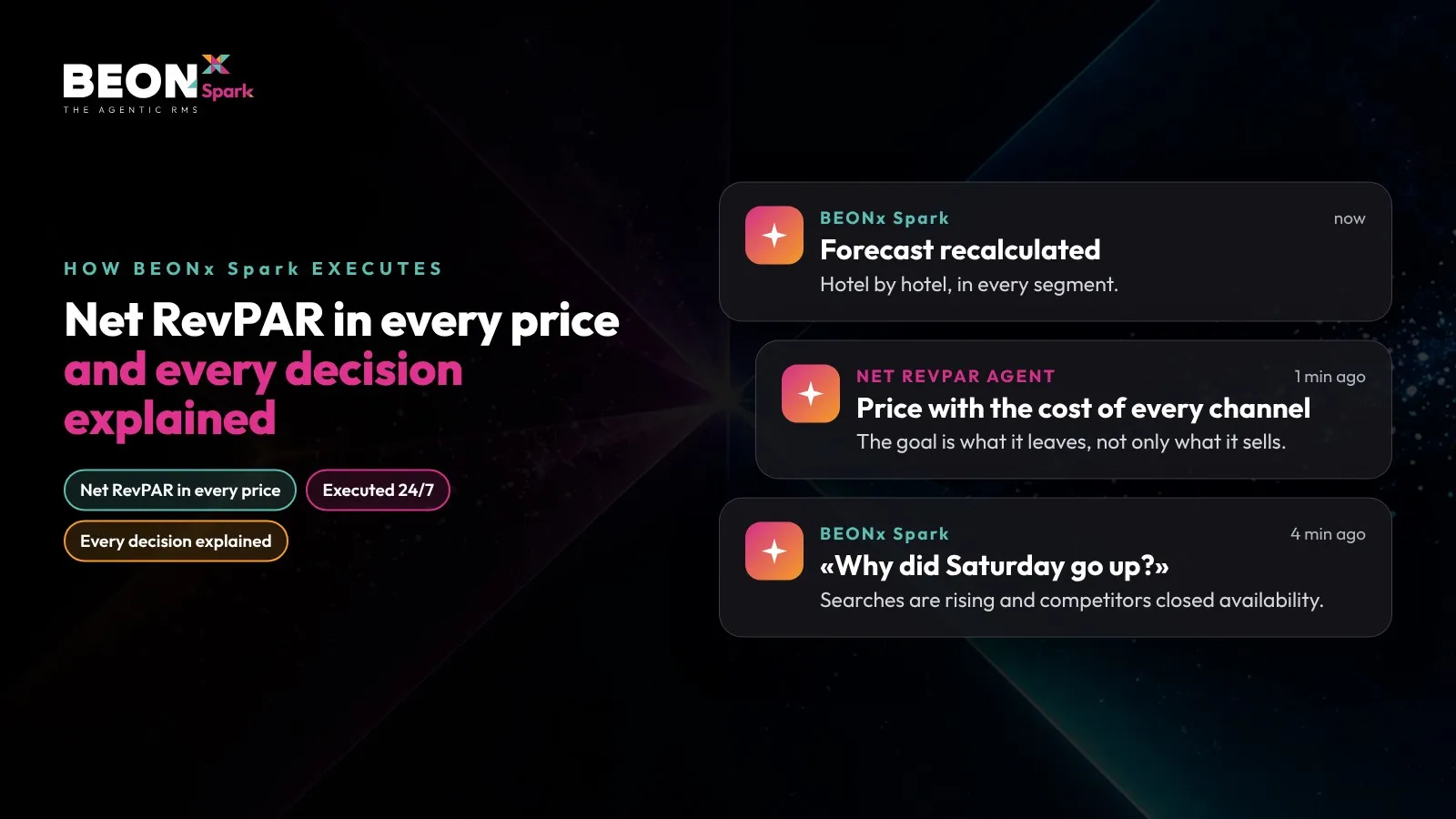
An Agentic RMS is a revenue management system with AI agents that execute the chain’s commercial strategy continuously, within its rules and limits, and explain every decision. BEONx Spark is the first Agentic RMS. To understand what that means, it helps to think in levels of autonomy, as with assisted driving:
| Level | Who decides | Who executes |
|---|---|---|
| L0 · Manual | A person | A person, with spreadsheets |
| L1 · Descriptive | A person | A person; the system shows what happened |
| L2 · Predictive | The system calculates, a person validates | A person |
| L3 · Agentic | A person sets objectives, rules and limits | The system, continuously; people step in by exception |
| L4 · Autonomous | The system | The system |
Most of the market is still at L2. BEONx Spark works at L3, and deliberately does not aim for L4: business objectives, such as whether this quarter is about defending share or profit, are set by a person accountable to a board, not by a model. The autonomy that makes sense is operational: the strategy delivers itself every day, within what the board has decided.
The board decides the objective, the limits and which decisions need approval. From there, the agents recalculate every hour or every fifteen minutes, depending on configuration, and execute the strategy across the portfolio. On any given day, the cycle looks like this:
It is the first question any IT director asks, and rightly so. Deloitte’s 2026 Travel Industry Outlook notes that European data protection rules on consent, profiling, transparency and automated decision-making are now central when AI is used to set prices, and its State of AI in the Enterprise 2026 shows that four in five companies still lack a mature governance model for their AI agents. An agent system that acts on the chain’s prices must be stricter than a tool that only reports.
In BEONx Spark, agents act with role-based permissions and never step outside the chain’s policies. Every action is logged with its data and its reason. The system respects the organisation’s data governance and privacy policies, and the chain decides which language model it uses and what information it shares. That is the difference between connecting your data to a general-purpose AI platform and working with a system designed to run business-critical processes.
Because a good pricing decision that finance does not understand, or that the board sees with a different figure, is worth little. And that is the norm when each department works with its own tool, its own extract and its own spreadsheet.
BEONx Spark is built for the whole organisation, not just the revenue team. Revenue, finance, sales, operations and every hotel manager work from the same data and the same explanations. Each contributes from its own area, but all push towards the same business objective, and the board receives consistent, aligned figures.
Today, in many chains, the answer is worrying. Commercial judgement lives in spreadsheets, minutes and people’s heads: it cannot be executed at machine speed, it cannot be audited and it leaves with whoever built it. With the talent shortage HOTREC describes, replacing that profile can take months.
An Agentic RMS changes that equation. The business model, rules, commercial policies and strategy are configured in the agents, which execute them and will orchestrate the rest of the chain’s technology. The knowledge stays with the company. And the chain can hire professionals who get the most out of the agents without depending on any one of them. The revenue manager stops being a data clerk and starts managing profitability.
A good evaluation separates, in a single meeting, the systems that execute the strategy from those that only accompany it. These are the questions we recommend taking to the next demo or RFP:
Towards orchestration. Today every hotel system brings its own AI, and without an orchestrator it is hard for them all to work to the same strategy and under the same security rules. BEONx Spark is designed so that PMS, channel manager, booking engine, CRM, guest experience and F&B work to one strategy, coordinated by One Brain and connected through open standards such as MCP. The chain that keeps its agentic layer, its data and its rules in one system will decide faster, and more profitably, than the one still coordinating ten different tools by hand.
It uses more data, forecasts demand hotel by hotel with high accuracy using machine learning and recalculates in real time. With an Agentic RMS such as BEONx Spark, it also executes the full strategy towards a profit objective and explains every decision.
No. A language model answers by probability, lacks the hotel’s history and compset and cannot execute in the PMS or channel manager. The price must be calculated by a model specialised in revenue.
Within limits. The team defines objectives, floors and ceilings, protected segments and which decisions need approval, and steps in by exception.
A revenue management system with AI agents that execute the chain’s commercial strategy continuously, within its rules and limits, and explain every decision. BEONx Spark is the first Agentic RMS.
RevPAR and Net RevPAR today, TRevPAR in 2027 and GOPPAR coming soon. The chain chooses the objective and the agent pursues it in every decision.
With role-based permissions, a log of every action, respect for the organisation’s data governance and privacy policies, and freedom to choose the language model it works with.
By turning the approved strategy into daily decisions: agents execute the objective the chain sets across every hotel and channel, 24/7, and every department sees the same data.
No. The revenue manager decides the strategy, the limits and the exceptions; the agents execute it. The chain reduces its dependence on specific individuals without giving up human judgement.
Sources:
2027 trends, how agents work, how they are governed and where to start. Written for boards and revenue teams.
Download the free «The Agentic RMS Guide for Hotel Chains» → · Talk to an expert →
Keep reading: Why do hotels miss profit with manual revenue tools?
About BEONx. BEONx was founded in Salamanca in 2012 to help hotels maximise their profitability. In 2026 it launched BEONx Spark, the first Agentic RMS: AI agents that execute a hotel chain’s commercial strategy 24/7, across its entire portfolio, within the limits the team sets and explaining every decision.
Costs are growing faster than revenue. Why chains with manual revenue management lose profit, and which technology to prioritise in the 2027 budget.

Discover how AI transforms revenue management beyond pricing, segment analysis and channel mix. Boost profitability with BEONx. Read more here!

Maximize hotel revenue and balance occupancy by integrating a tour operator module into your RMS, optimizing pricing and strategic decisions.
Speak with one of our dedicated hotel experts and get started on your journey to sustainable profitability.
Other Articles

Learn how Lungarno Collection increased ADR by 5-10% and automated pricing strategies using BEONx AI-driven Revenue Management System.

How Omena Hotels strengthened profitability and improved RevPAR through automation, forecasting and real-time pricing intelligence with BEONx.
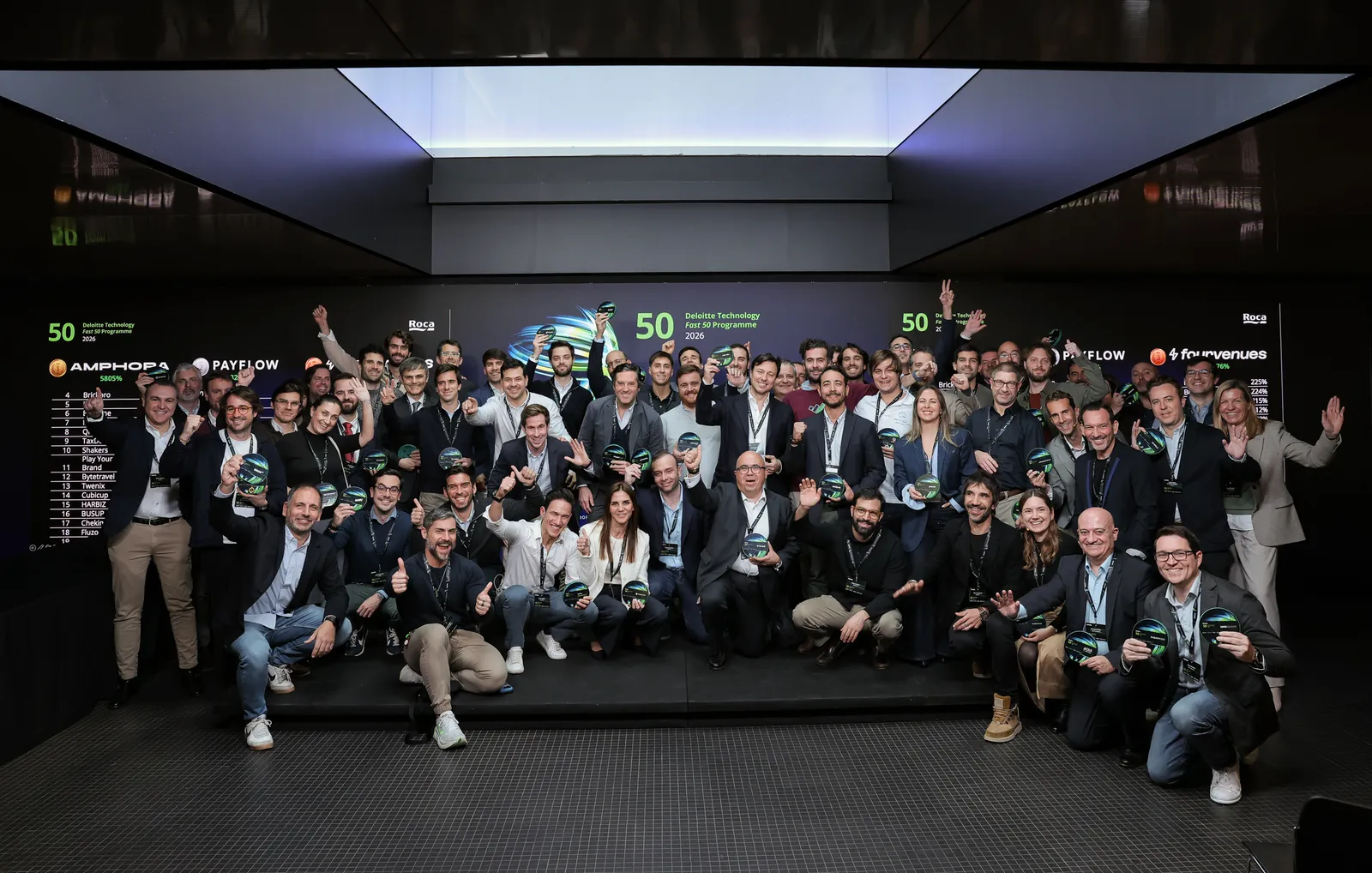
Deloitte has announced the results of the latest edition of the “Deloitte Technology Fast 50 Programme,” the prestigious ranking that identifies the 50 most scalable technology com
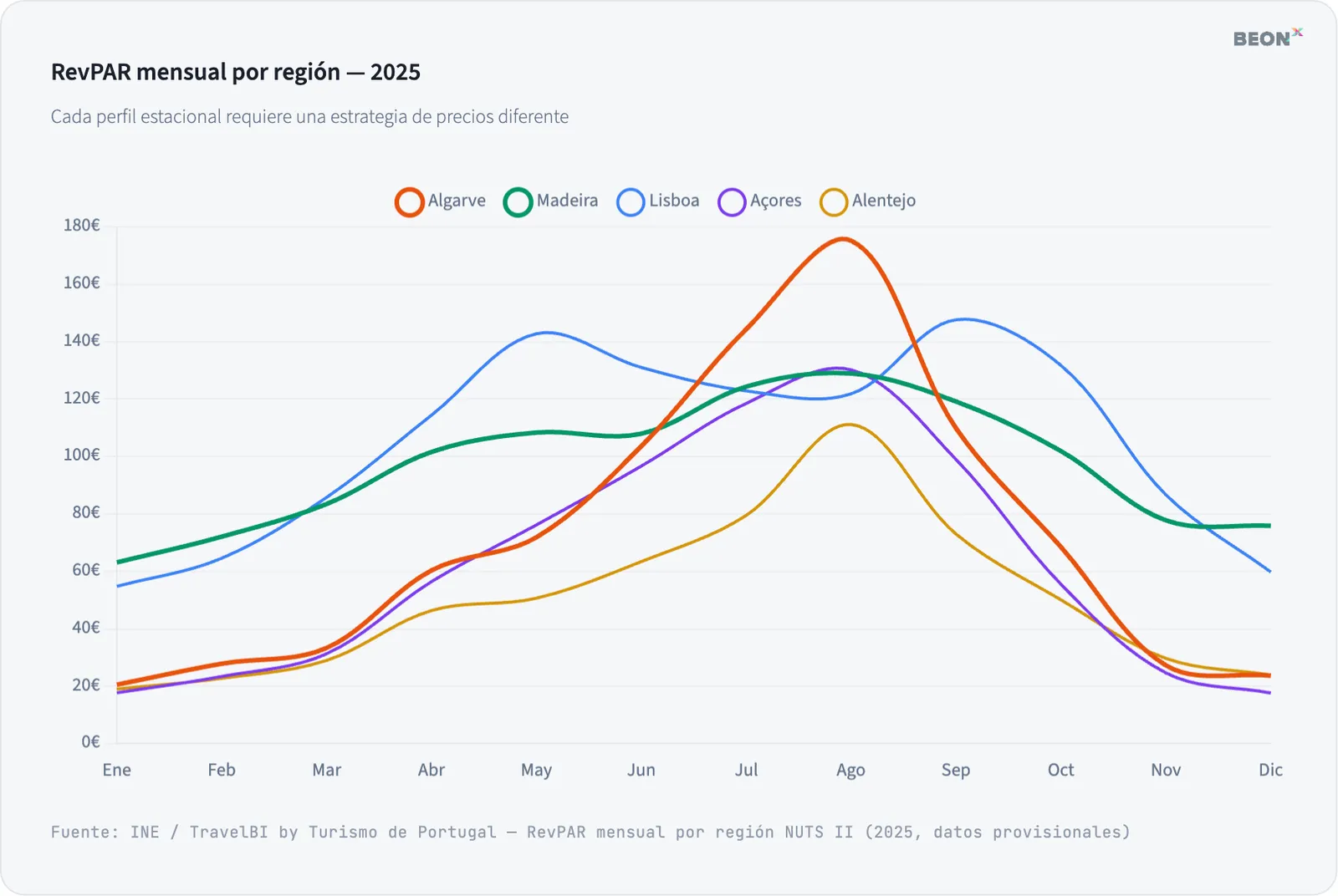
Growth that is losing momentum The hotel market in Portugal continues to break records year after year, but the data reveals a more nuanced reality, a RevPAR of €72.38, growth of +
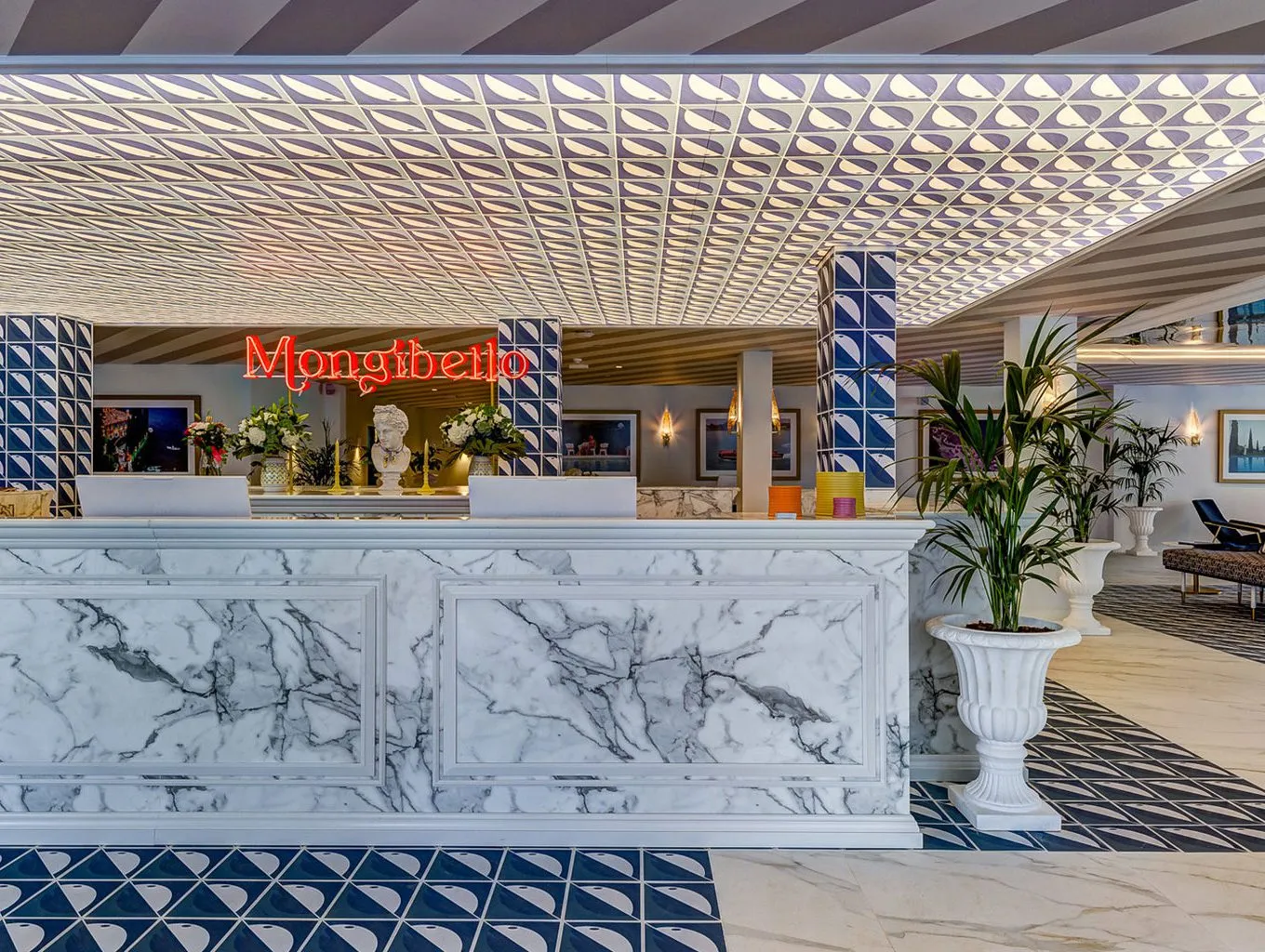
Concept Hotel Group boosts revenue performance with BEONx through automation, Smart Range, and data-driven decision-making.

From intuition to intelligence: how Kora Living achieved 20% RevPAR growth and built a smarter, data-driven revenue strategy with BEONx.

Colombia’s hotel industry is evolving fast. Learn how to anticipate demand, use AI to optimize pricing, and compete on value rather than price. A vision of the future of revenue management from BEONx, Lighthouse, and CloudBeds.
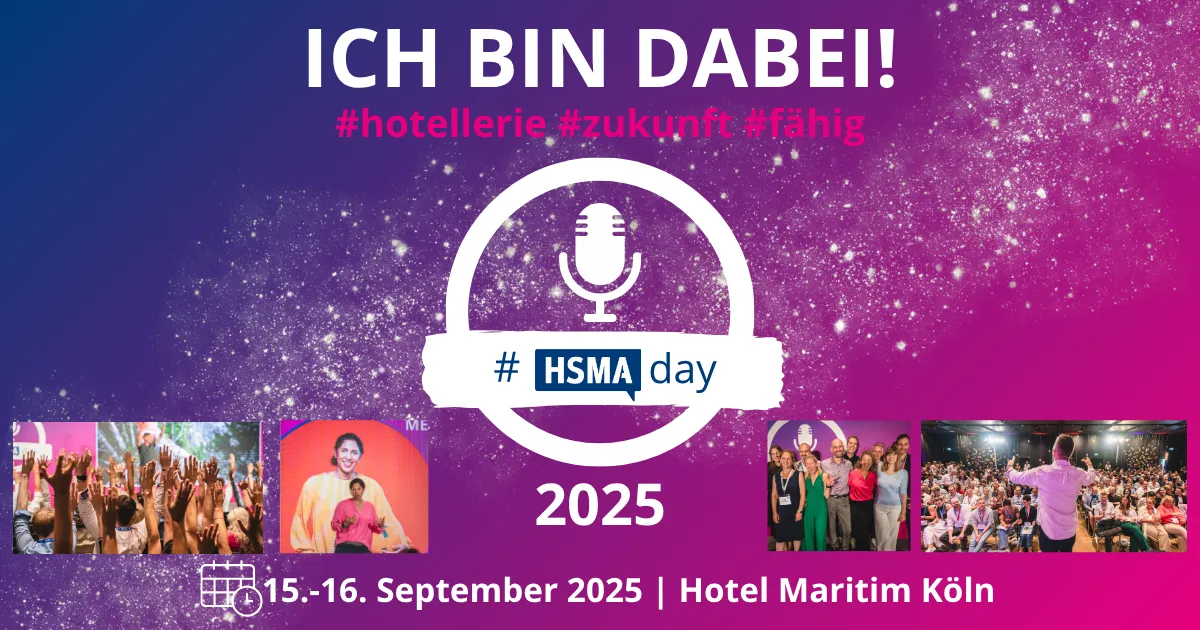
On September 15–16, 2025, BEONx participated in HSMAday 2025, held at the Maritim Hotel in Cologne. The event brought together over 500 professionals from the hospitality sector to

BEONx empowered Kali Hoteles team to move from reactive to proactive pricing strategies, detect market shifts early, and implement optimal pricing by room type—improving not just profitability but also internal collaboration and confidence. %

Redefine your pricing strategy with SmartRange by BEONx – the AI-powered model that stabilises rates, minimises volatility and boosts profitability beyond the compset.