RSBy Rubén Sánchez Martín, co-founder and CEO of BEONx. Computer Engineer from the University of Salamanca, with executive education at Cambridge and Harvard. He has spent more than a decade helping hotel chains with revenue management technology.
Short answer
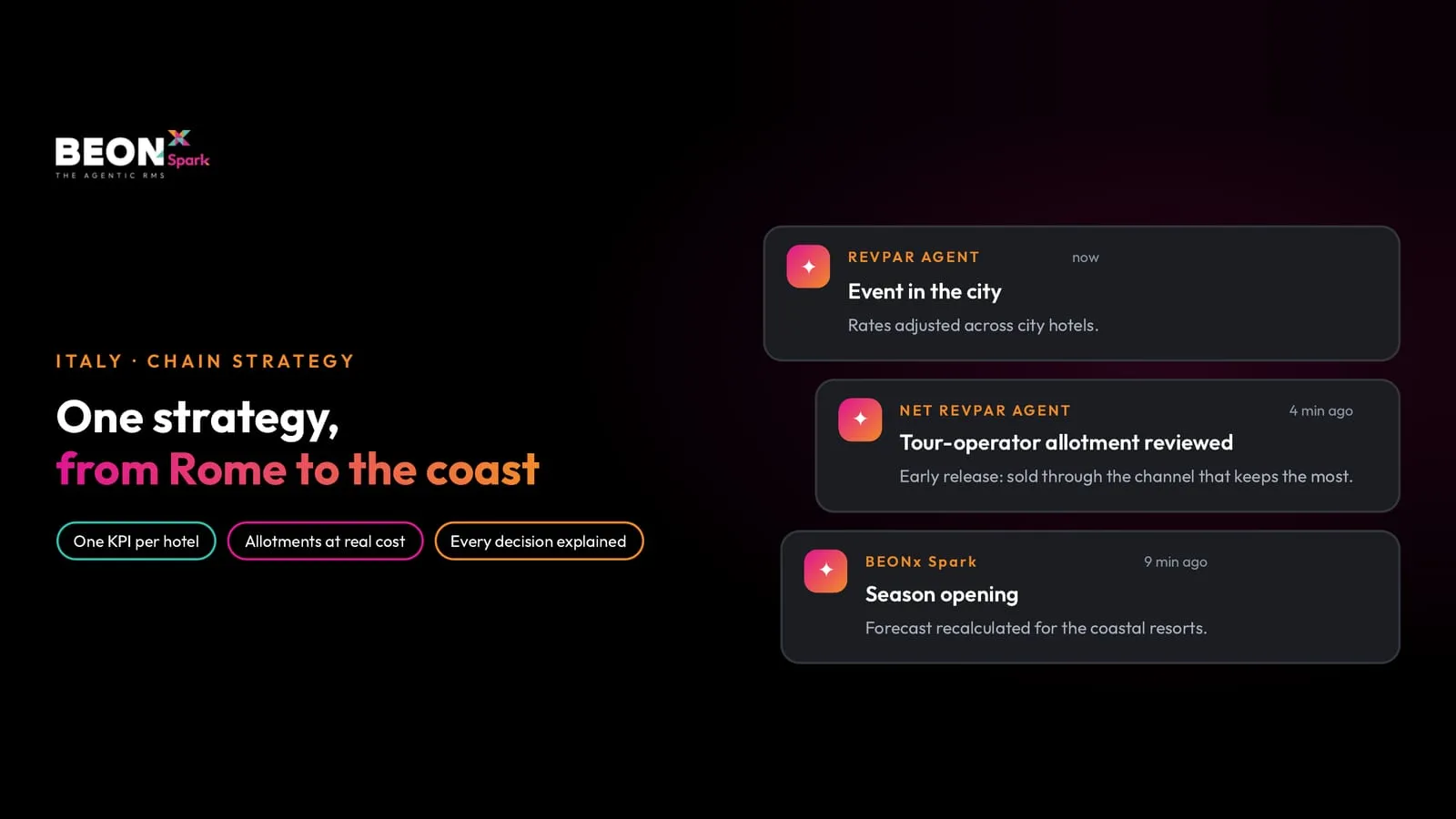
The best revenue management system for a hotel chain in Italy runs very different hotels, from an art-city property to a seaside resort, with a single strategy; sets each hotel’s KPI; accounts for the cost of every channel and tour operator; and executes rates in real time while explaining every decision. BEONx Spark, the first Agentic RMS, is built for that: its AI agents execute the chain’s strategy 24/7 within the limits the team sets.
What is the best RMS for hotel chains in Italy?
The one that can run very different hotels with a single strategy. A typical Italian chain combines hotels in art cities, coastal resorts open a few months a year and mountain or lakeside properties. Each has its own demand pattern, channels and costs.
A good revenue management system for that portfolio lets the chain set each hotel’s objective, understands the season and tour-operator allotments, builds each channel’s cost into the rate and executes the strategy in real time, explaining every decision to the team and the owners.
How is the Italian hotel market doing in 2026?
Growing faster than almost anyone in Europe. In the first half of 2026, Italian hotel RevPAR rose 11.3%, against a European average of 3.0%, according to Cushman & Wakefield. Only Bulgaria and Hungary grew faster.
The key is how it was achieved: average rate rose by around 10% and occupancy by only around 1%. Italy welcomed 88 million tourist arrivals in the half (+4.4%), 35 million of them international (+6.5%). And more than 80 hotels opened, half of them four-star.
When growth comes from rate, the question is no longer how much to raise it, but how much of that rise reaches the P&L.
Why is rate growth not enough?
Because in Europe costs are rising faster than revenue. In the same half, gross operating profit per available room at full-service urban hotels in Europe grew only 1.0%, and improved in only half of the markets analysed.
In Italy, three items add to that which RevPAR cannot see: tourist tax, energy and seasonal staff. And a fourth that is very Italian: the weight of tour operators and allotments in resorts. An RMS that only maximises revenue can fill a resort through the channel that leaves the least.
What makes the Italian market different?
- Highly diverse portfolios. One chain can run hotels in Rome, Florence or Venice, resorts in Sardinia, Sicily or the Riviera and properties in the Alps or the lakes.
- Short seasons on the coast and in the mountains. Much of the year is decided in a few months, with openings and closings the system must understand.
- Tour operators and allotments. Releasing an allotment late, or selling it through the wrong channel, costs profit.
- Growing family-owned groups. Many chains start as family groups that grow from a few hotels to dozens and need to professionalise revenue without multiplying the team.
- Events that move demand. The 2026 Winter Games sent Milan’s rates soaring in February: big events change pricing within days.
What should an Italian hotel chain ask of its RMS?
What an Italian hotel chain should ask of its RMS| Challenge in Italy | What the system must do |
|---|
| Art-city hotel and resort in the same chain | One chain strategy with a KPI and rules per hotel |
| Short seasons | Forecasts that react to events and openings, not fixed cycles |
| Tour operators and allotments | Account for each channel's cost and allotment releases in the rate |
| Small, growing teams | Execute the strategy within limits, without repeated manual work |
| Profit by hotel | Choose the KPI, from revenue to profit, and track Net RevPAR |
| Owner confidence | Explain every decision in plain language, with the data behind it |
How does an agentic RMS manage tour-operator allotments?
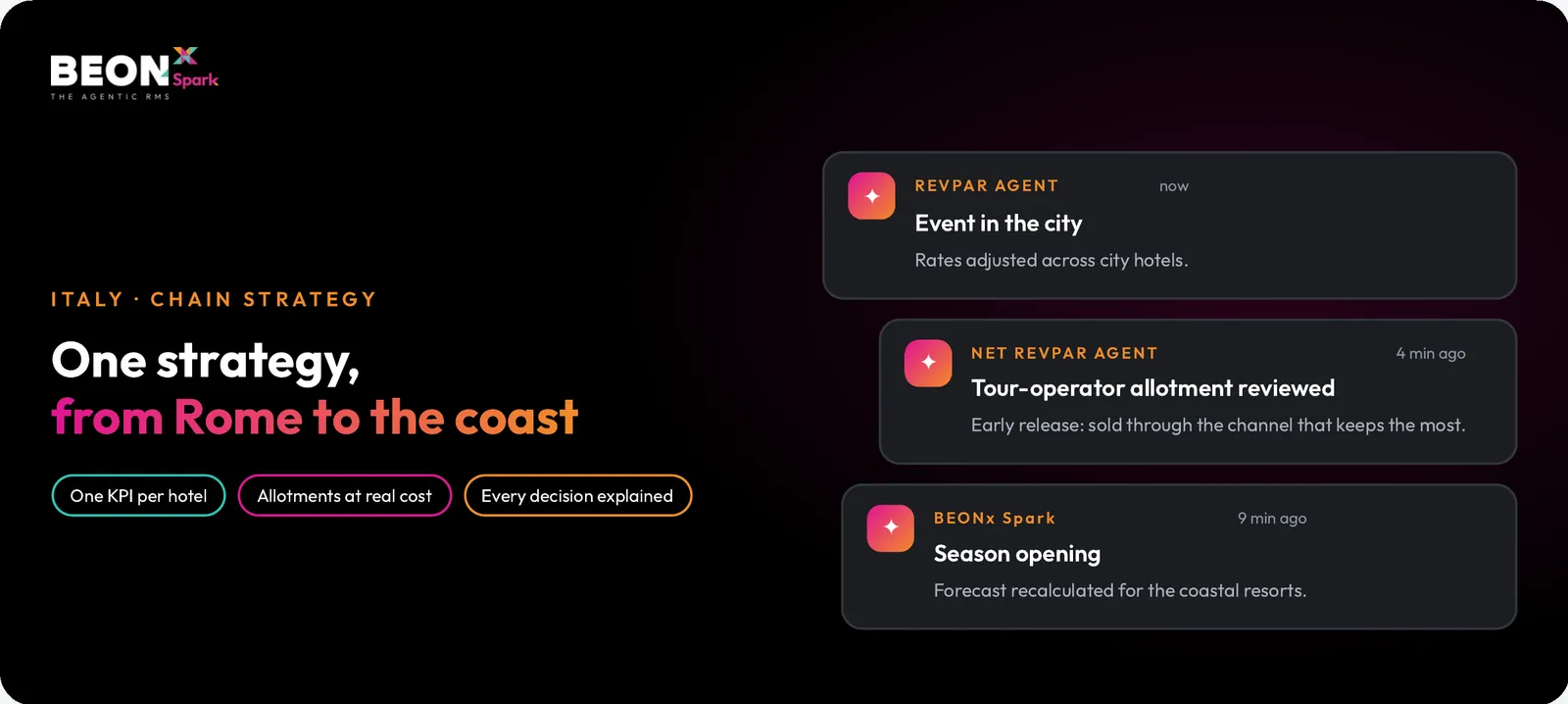
As one more channel, at its real cost. The agent compares what each night sold through the tour operator leaves with what it would leave through the direct channel or an OTA, watches release dates and proposes or executes, within the team’s limits, when to take back inventory and at what rate to sell it. Every decision is logged so it can be reviewed with the tour operator and the owners.
Does a small or mid-sized chain need an agentic RMS?
That is where it helps most. A chain of 10 to 30 hotels usually has one or two revenue managers. With an agentic RMS, the strategy is applied the same way in every hotel, every day, without the team having to grow as fast as the portfolio. The revenue manager decides; the agents execute.
How does BEONx Spark approach it?
BEONx Spark is the first Agentic RMS: AI agents execute the strategy set by the revenue team and orchestrate the PMS, channel manager, booking engine and CRM.
- One strategy, many hotels. The chain sets each hotel’s KPI and limits; the agents apply them in real time.
- One agent per objective. The RevPAR Agent maximises revenue per available room and the Net RevPAR Agent what is left after paying each channel, including tour-operator allotments and releases. TRevPAR arrives in 2027 and GOPPAR soon after.
- A glass box, not a black box. The team and the owners ask why a rate changed and get the answer with the data.
- A team in Southern Europe. BEONx has its own sales team in Southern Europe, Italy included, and was at TTG Rimini 2026.
Frequently asked questions
What is the best revenue management system for hotel chains in Italy?
One that runs city, coastal and mountain hotels with a single strategy, accounts for the cost of each channel and tour operator, and explains every decision. BEONx Spark, the first Agentic RMS, is built for that.
How much did RevPAR grow in Italy in 2026?
11.3% in the first half, against a European average of 3.0%, according to Cushman & Wakefield. Growth came mainly from average rate.
Does an AI RMS work for seasonal resorts?
Yes, if its forecasts react to events and openings and it manages tour-operator allotments at their real cost.
What is Net RevPAR?
Revenue per available room after deducting each booking’s distribution cost.
Does a small chain need an agentic RMS?
That is where it helps most: it executes the strategy in every hotel without the team having to grow as fast as the portfolio.
Sources:
Free download: “The Agentic RMS Guide for Hotel Chains”
2027 trends, how the agents work, how they are governed and where to start. Written for executive committees and revenue teams.
Download “The Agentic RMS Guide for Hotel Chains” → · Talk to an expert →
Keep reading: How do you choose an AI revenue management system that maximises RevPAR and Net RevPAR?
About BEONx. BEONx was founded in Salamanca in 2012 to help hotels maximise their profitability. In 2026 it launched BEONx Spark, the first Agentic RMS: AI agents that execute a hotel chain’s commercial strategy 24/7, across its whole portfolio, within the limits the team sets and explaining every decision.