
BEONx launches BEONx Spark, the first agentic RMS on the market
With BEONx Spark, hoteliers set the strategy and AI agents execute it across all their hotels. 24/7. Beyond RevPAR. Explaining every decision.


BEONx
What is lead time and how do you calculate it? Why is tracking lead time so important? Read on to find out.
As a hotel revenue manager, one of your core functions is understanding and anticipating customer behaviour so that you can make the right strategic decisions and optimise your prices accordingly. This is the most effective method for increasing the level of revenue your business generates. Part of this is down to instinct, but you also need to rely on the right data. That’s why it’s so important to have access to the right performance analytics. The obvious KPIs that you should be tracking include RevPAR and occupancy rates but tracking your lead time is equally important.
What is lead time and how do you calculate it? Why is tracking it so important? Read on to find out.

Lead time is a powerful KPI in revenue management that provides valuable insights into customer behaviour. Essentially, it is a formula used to calculate the time between a guest confirming a reservation at your hotel, and their arrival date. The aim, as a revenue manager, is to optimise your lead time as this can lead to a significant increase in revenues.
A longer lead time can help you anticipate revenues and optimise resource costs. This is because each department in your hotel has enough notice to prepare for a guest’s arrival. For example, the kitchen can buy supplies and plan menus in advance, and housekeeping can make sure they have enough staff on duty to manage busy periods (and, conversely, make sure there are fewer members of staff on duty during periods that are anticipated to be quiet). You can also plan promotions and price adjustments if you know that certain dates are going to be quiet and get those all-important occupancy rates up in advance.
However, it’s not always as simple as aiming for a longer lead time. If it is too long, then it might suggest that there is an issue with your pricing strategy. For example, if you are filling rooms much quicker than your competitors then it could suggest that your prices are lower than the market value.
Optimising your lead time is all about understanding the specific nuances of your booking window and finding the right balance, also taking into account your cancellation rate and no-show rate.
Download the Total Profit Checklist now and become the revenue superhero!
So, how do you calculate lead time?
It’s simple. You just need to calculate the number of days between a guest making a reservation and their actual check-in date. So, for example, if a guest makes a reservation on August 1st and they check in on August 15th, then the lead time for that reservation is 15 days. If, for the same booking, they reserve on the same day as arrival, then the lead time is 0 days.
Although the calculation is simple, calculating each guest’s lead time manually can take a lot of time, especially if you are a large hotel with a high level of occupancy. You can speed up the process slightly by using Excel and the right formulas to quickly calculate your lead time, but you still have to manually enter names, booking dates and arrival dates, and that can quickly eat into your time and prevent you from working on more strategic matters such as working on fair pricing strategies.
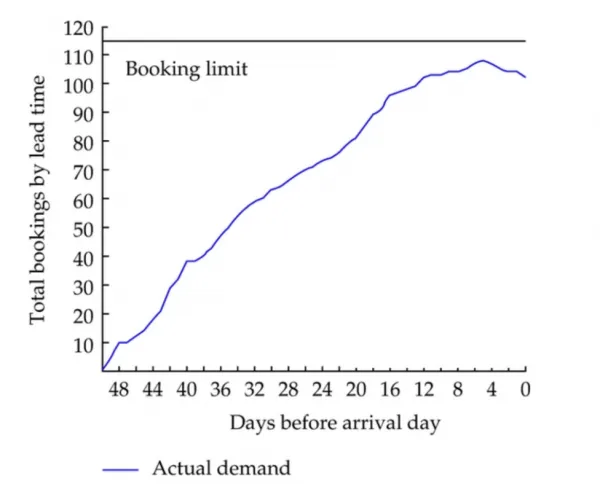
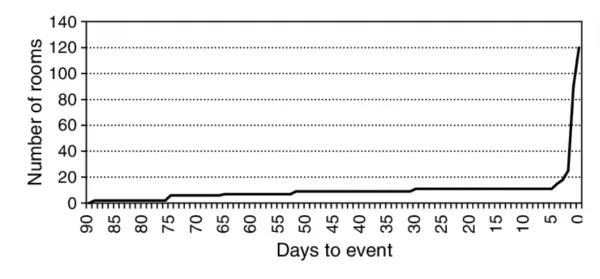
Another more efficient method for calculating your lead times is using revenue management software. An RMS streamlines the process by taking the data straight from your channel manager. To view your lead times, simply access the platform and run reports on the automatically generated KPI. The booking pace curves can also help you understand your lead time.
High lead time would create this kind of booking curve:
Low lead time will show a different booking curve:
Consumer behaviour has changed since the pandemic. Part of this is down to the unpredictable nature of demand these days. But the way in which people make reservations has also changed as a result of the boom in technology and the proliferation of booking platforms and channels. Traditionally, guests would plan a journey far in advance, which made it easier for hotels to plan ahead and ensure they had the right staffing levels and supplies to provide the best possible experience. They also had time to implement alternative strategies in order to fill rooms during quiet periods. However, these days people can make a last-minute reservation straight from their phone within a matter of seconds. This makes it much harder to predict consumer behaviour.
Tracking your this KPI can be a valuable piece in understanding your target market and it can help you predict future trends and anticipate high and low demand. With the right data, you can begin to identify patterns and learn how your target market works. You can then make adjustments to your pricing and marketing strategies in order to sell more rooms to more guests at the right price.
With BEONx Spark, hoteliers set the strategy and AI agents execute it across all their hotels. 24/7. Beyond RevPAR. Explaining every decision.

Deloitte has announced the results of the latest edition of the “Deloitte Technology Fast 50 Programme,” the prestigious ranking that identifies the 50 most scalable technology com
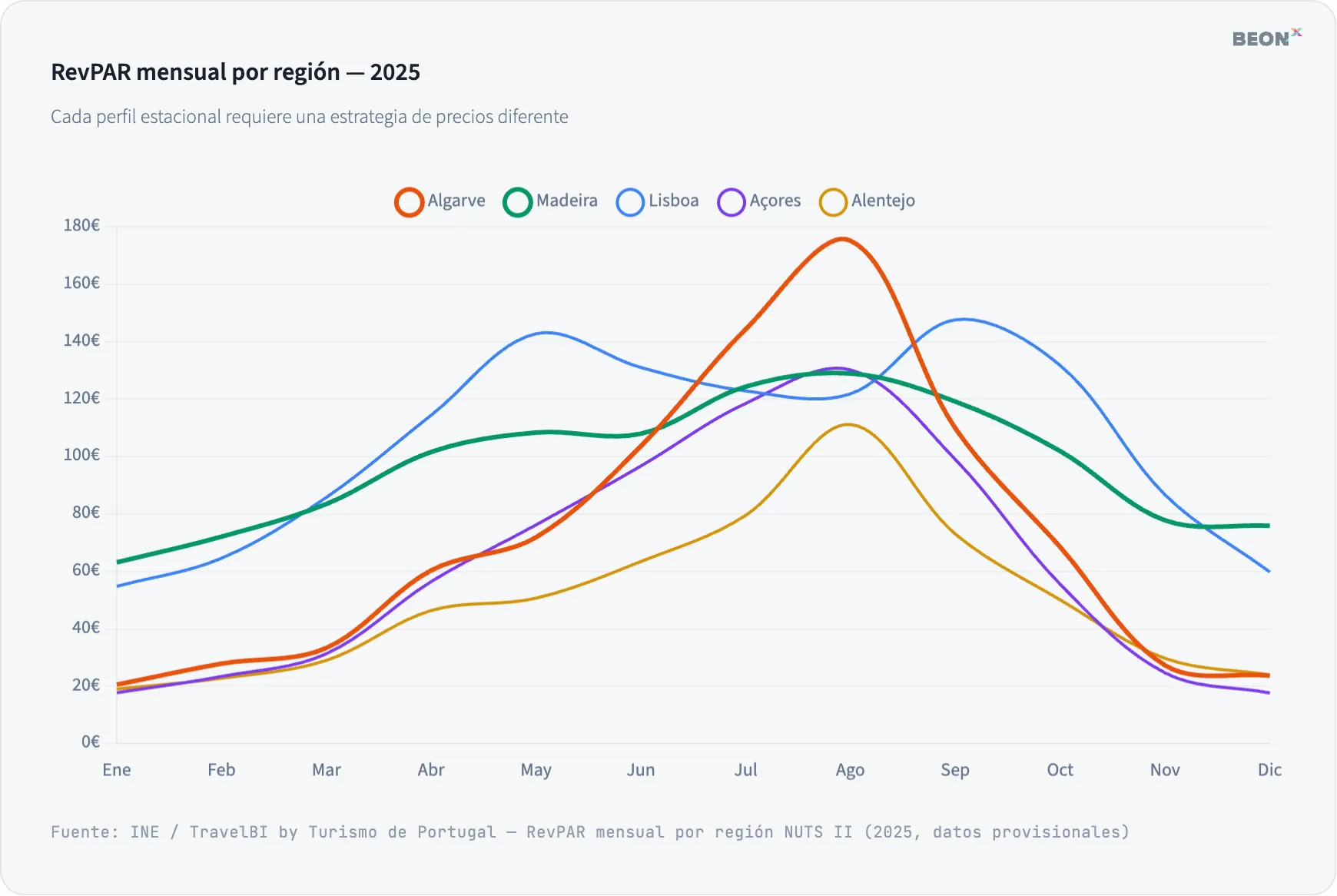
Growth that is losing momentum The hotel market in Portugal continues to break records year after year, but the data reveals a more nuanced reality, a RevPAR of €72.38, growth of +
Speak with one of our dedicated hotel experts and get started on your journey to sustainable profitability.
Other Articles

Learn how Lungarno Collection increased ADR by 5-10% and automated pricing strategies using BEONx AI-driven Revenue Management System.
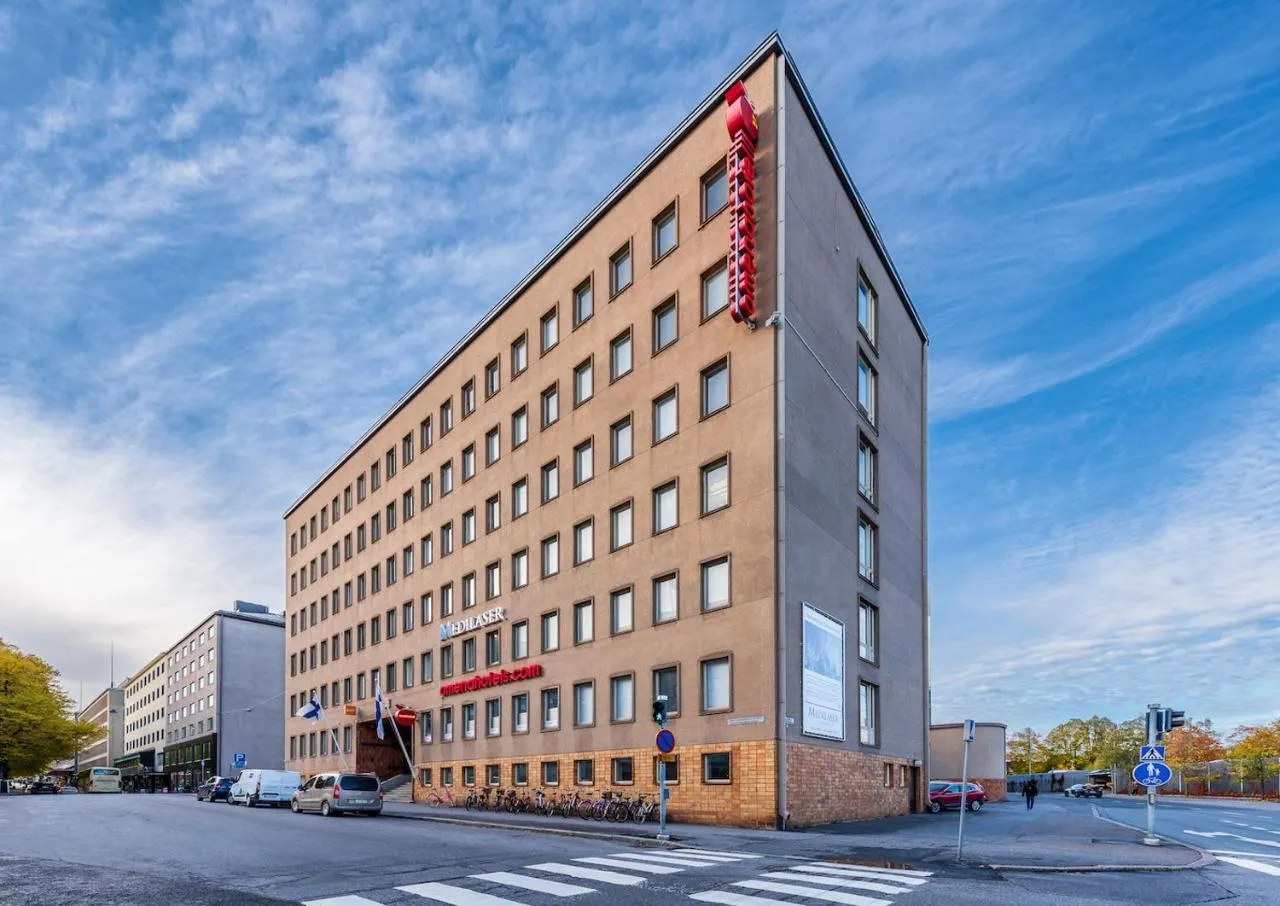
How Omena Hotels strengthened profitability and improved RevPAR through automation, forecasting and real-time pricing intelligence with BEONx.
Deloitte has announced the results of the latest edition of the “Deloitte Technology Fast 50 Programme,” the prestigious ranking that identifies the 50 most scalable technology com
Growth that is losing momentum The hotel market in Portugal continues to break records year after year, but the data reveals a more nuanced reality, a RevPAR of €72.38, growth of +
Concept Hotel Group boosts revenue performance with BEONx through automation, Smart Range, and data-driven decision-making.

From intuition to intelligence: how Kora Living achieved 20% RevPAR growth and built a smarter, data-driven revenue strategy with BEONx.

Colombia’s hotel industry is evolving fast. Learn how to anticipate demand, use AI to optimize pricing, and compete on value rather than price. A vision of the future of revenue management from BEONx, Lighthouse, and CloudBeds.
On September 15–16, 2025, BEONx participated in HSMAday 2025, held at the Maritim Hotel in Cologne. The event brought together over 500 professionals from the hospitality sector to

BEONx empowered Kali Hoteles team to move from reactive to proactive pricing strategies, detect market shifts early, and implement optimal pricing by room type—improving not just profitability but also internal collaboration and confidence. %

Redefine your pricing strategy with SmartRange by BEONx – the AI-powered model that stabilises rates, minimises volatility and boosts profitability beyond the compset.